
The History of Dream Interpretation: From Ancient Temples to Modern Science
People have interpreted dreams for millennia. Surviving texts from Mesopotamia and Egypt offer examples of dreams understood as omens or divine encounters. Later writers also explored natural and psychological explanations. This history traces several of those approaches while separating historical beliefs from findings in sleep research.
Quick answer
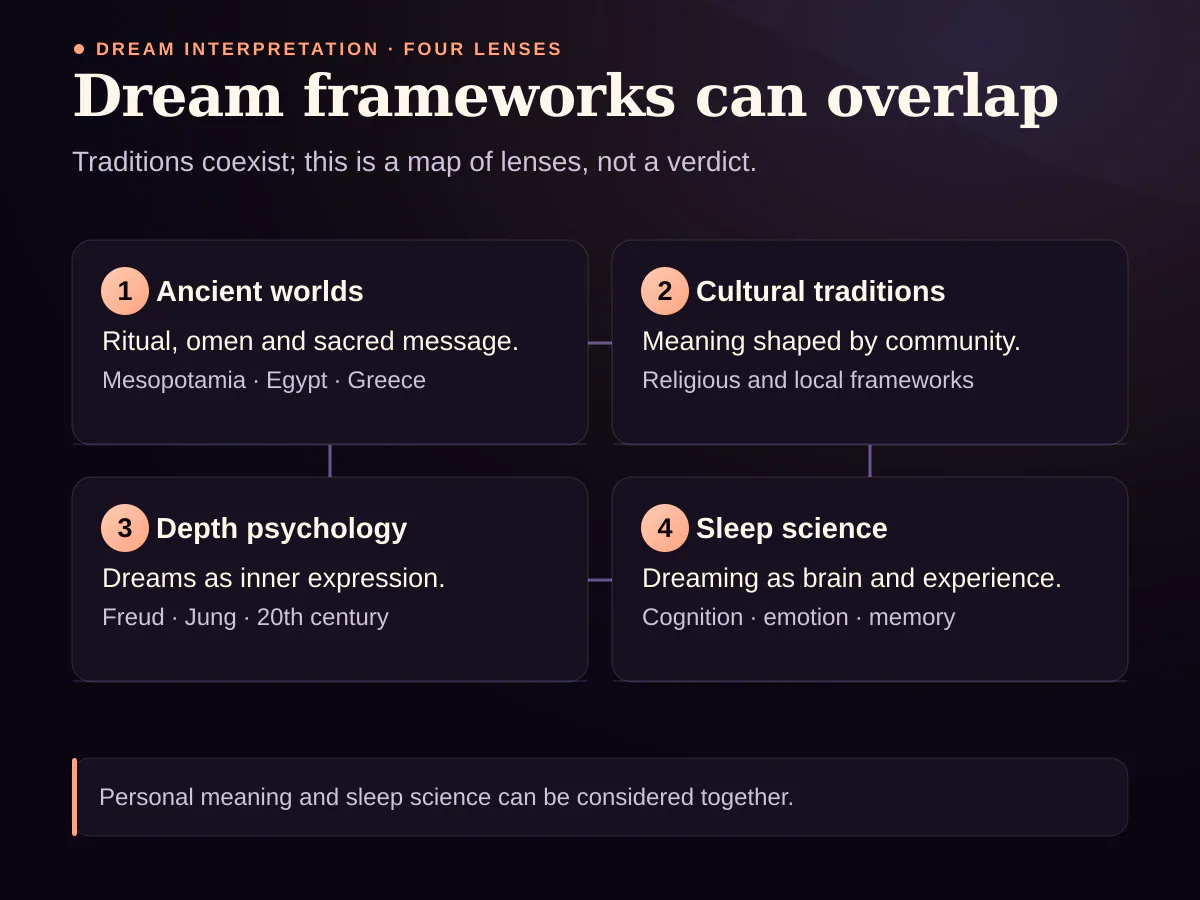
Surviving ancient texts document dream interpretation long before Freud and Jung. Religious readings, natural explanations and psychological theories have coexisted rather than simply replaced one another. Modern sleep research studies measurable aspects of dreaming; it does not establish a universal code for dream symbols.
Dream interpretation timeline at a glance
2120–2110 BCE: Gudea's narrative
A surviving cylinder describes a dream about building a temple.
Ancient Egypt: a dream manual
Papyrus Chester Beatty III preserves a written dream book.
Ancient and medieval explanations
Aristotle and, later, Aquinas considered different causes of dreams.
Psychoanalysis and sleep experiments
Freud and Jung offered interpretive theories; laboratory research later investigated sleep physiology and dream reports.
Dream Interpretation in Ancient Mesopotamia: A Documented Dream
The Louvre dates Cylinder A of Gudea to 2120–2110 BCE. Its inscription describes the god Ningirsu appearing to Gudea in a dream and directing the construction of a temple. The narrative connects the ruler's building project with divine authority.
This is a specific surviving example of the religious role of dreams in ancient Mesopotamia. It does not tell us who first interpreted a dream: the date of an object is different from the beginning of a human practice.
Dream Interpretation in Ancient Egypt: A Written Manual
Papyrus Chester Beatty III in the British Museum includes a dream book written in hieratic script. It offers another kind of evidence: a manuscript devoted to interpreting dreams, rather than a royal account of one dream.
Reading such texts helps us understand a historical practice. Their survival does not validate the predictions they contain, and a single manuscript cannot represent everything ancient Egyptians believed about dreaming.
Ancient Greece: Natural Explanations of Dreams
In On Dreams, Aristotle examines dreaming through perception and imagination. He considers how sensory impressions can persist when their original objects are no longer present. This is an attempt to explain a mental experience through natural processes, many centuries before psychoanalysis.
His separate work On Prophesying by Dreams addresses prediction. It considers bodily signs, actions prompted by a dream and coincidences. This discussion connects dreams with questions about health as well as divination; it is not a modern diagnostic method.
These texts complicate a simple story in which all ancient people saw dreams as supernatural messages. They also show why explanations of how dreams arise should be distinguished from claims about what a particular dream predicts.
A Religious Dream Narrative: Joseph and Pharaoh
In Genesis 41, Joseph interprets Pharaoh's dreams of cattle and grain as seven years of abundance followed by seven years of famine. Within the narrative, the interpretation is attributed to God and leads to a plan for storing food.
This passage provides a concrete example of dream interpretation in a religious text. It should be read as that text's account, rather than as experimental evidence for prediction or a summary of every Jewish or Christian view.
Medieval Perspectives: Aquinas on the Causes of Dreams
In Summa Theologiae, question 95, article 6, Thomas Aquinas asks whether divination through dreams is unlawful. His answer distinguishes natural causes, including bodily conditions and waking thoughts, from supernatural causes within his theological framework.
The passage shows natural and religious explanations appearing together in one medieval argument. Treating the whole period as either unquestioning belief or rejection of dreams would obscure that distinction.
Ancient texts
Gudea's narrative, an Egyptian manual and Aristotle's treatises document different approaches.
Medieval theology
Aquinas discusses natural and supernatural causes within a religious framework.
Modern approaches
Psychoanalytic interpretation and experimental sleep research ask related but distinct questions.
Freud's Approach: Wishes and the Unconscious
In The Interpretation of Dreams, Freud developed a psychoanalytic account of dreams involving wishes, associations and disguised meanings. His opening review discusses earlier writers; he did not invent dream interpretation or the attempt to explain dreams psychologically.
- Manifest content: the remembered dream as it is reported.
- Latent thoughts: the thoughts Freud sought to reconstruct through analysis.
- Dream work: the transformations he proposed between those thoughts and the remembered dream.
Freud's method gave the dreamer's associations a central role. These concepts describe a historical theory, not established rules for decoding every dream. Reading the original also helps distinguish his argument from a dictionary that assigns one fixed meaning to each image.
Jung: Dreams and Mythology
In Psychology of the Unconscious, Jung compares dream and fantasy material with mythology. His interpretation moves between an individual's images and stories from other settings, offering a different emphasis for readers interested in symbolic associations.
Those comparisons belong to Jung's theoretical approach. Similar images in separate accounts do not, by themselves, prove that a symbol has the same meaning for everyone. The text is useful for understanding his method without adopting its assumptions as scientific findings.
Modern Dream Research: What Can Be Measured?
In 1953, Aserinsky and Kleitman reported recurring periods of rapid eye movements during sleep. This became an important landmark for experimental research on REM sleep and dreams.
Later work, including Siclari and colleagues' 2017 study, investigated dreaming in both REM and non-REM sleep using brain recordings and reports obtained after awakenings. Physiological measurements help researchers investigate dream experience; they do not reveal the personal meaning of a dream by themselves.
Dreams and waking experience
In a 2003 diary study, 29 participants recorded dreams and daily experiences over 14 days. Researchers reported that 65% of 299 sleep reports included aspects of recent waking life, while only 1–2% replayed an episode. The figure describes reports in one study, not a universal proportion of dream content.
Proposed functions are still hypotheses
Revonsuo's threat-simulation hypothesis proposes that dreaming could provide rehearsal for threatening situations. A proposed function is different from an established explanation for every nightmare. Likewise, a finding about sleep and memory does not automatically demonstrate an effect caused by dreaming itself.
Communication during lucid dreams
In a 2021 study involving 36 participants, experimenters obtained correct responses on 29 occasions from six participants during verified REM sleep. This was a limited demonstration of communication with sleeping dreamers, not the ability to read an entire dream.
Reading Dream Beliefs in Their Cultural Context
A single account cannot represent every member of a religion, region or community. When reading an interpretation, ask who recorded it, when, and whether it describes a belief, a personal practice or a research finding. Avoid assigning one meaning to an image simply because it is associated with a broad cultural label.
The history of dream interpretation brings together different ways of asking what dreams mean. Ancient texts document practices; psychological theories offer interpretive frameworks; sleep experiments investigate measurable aspects of dreaming. Keeping those forms of evidence distinct makes the history more useful without turning any one approach into a universal code.
Explore Related Symbols
Explore individual symbol guides, or browse the dream symbols dictionary.
Frequently Asked Questions
Who first interpreted dreams?
We cannot identify the first person to interpret a dream. A surviving example is Cylinder A of Gudea, dated by the Louvre to 2120–2110 BCE, which describes a dream about building a temple. It documents an ancient practice, not its exact beginning.
Did Freud invent dream interpretation?
No. Freud developed a psychoanalytic account of dreams involving wishes, associations and disguised meanings. Ancient texts already discussed dreams, and Aristotle explored natural explanations long before Freud.
How do different cultures interpret dreams differently?
Dream beliefs need to be described in a specific historical and cultural setting. One text cannot represent an entire community. Ask who recorded an interpretation and whether it describes a belief, a personal practice or a research finding.
What changed with modern dream science?
Laboratory studies combine physiological measurements with dream reports, including reports from REM and non-REM sleep. They investigate measurable aspects of dreaming without establishing a universal meaning for a particular dream symbol.
Sources / Further Reading
- Louvre — Cylinder A of Gudea, MNB 1512
- British Museum — Papyrus Chester Beatty III, EA10683,3
- Aristotle — On Dreams, translated by J. I. Beare
- Aristotle — On Prophesying by Dreams, translated by J. I. Beare
- Genesis 41 — King James Version
- Thomas Aquinas — Summa Theologiae, II–II, question 95, article 6
- Sigmund Freud — The Interpretation of Dreams, A. A. Brill translation
- C. G. Jung — Psychology of the Unconscious, Beatrice M. Hinkle translation (1916)
- Aserinsky and Kleitman (1953) — Regularly occurring periods of eye motility, and concomitant phenomena, during sleep
- Siclari et al. (2017) — The neural correlates of dreaming
- Fosse et al. (2003) — Dreaming and episodic memory: a functional dissociation?
- Revonsuo (2000) — The reinterpretation of dreams: an evolutionary hypothesis of the function of dreaming
- Konkoly et al. (2021) — Real-time dialogue between experimenters and dreamers during REM sleep
Read next
More resources on the same topic
Why Do We Forget Our Dreams? The Science Behind Dream Amnesia
Discover the brain mechanisms and neurochemistry that explain why we forget 95% of our dreams upon waking.
ScienceCan Dreams Predict the Future? The Science of Precognitive Dreams
Explore the fascinating science behind precognitive dreams and whether they can really predict the future.
ScienceDreams and Mental Health: How Your Sleep Reveals Your Mind
Discover the deep connection between dreams and mental health. Learn how anxiety, depression, and trauma affect your dreams, and how dream work can support healing.
Last updated: